Backstory as a Behaviour Seed
A backstory is not decoration. It is the vocabulary budget a character draws on, and changing one line of it changes the reply before you have typed anything of your own. Two entries can sit close together on the trends board — 24.3M views with 7.1K favourites on one card, 18.2M with 4.7K on another, read 22 Sept 2026 — and still produce completely different registers, because the description above the counters is doing the steering.

Key takeaways
- A backstory sets vocabulary before it sets plot: an occupation, an era and a social register narrow the words a reply is likely to choose.
- Crushon describes its Porn Chat AI characters as having unique personalities, appearances and interaction styles, which is what a backstory is shaping.
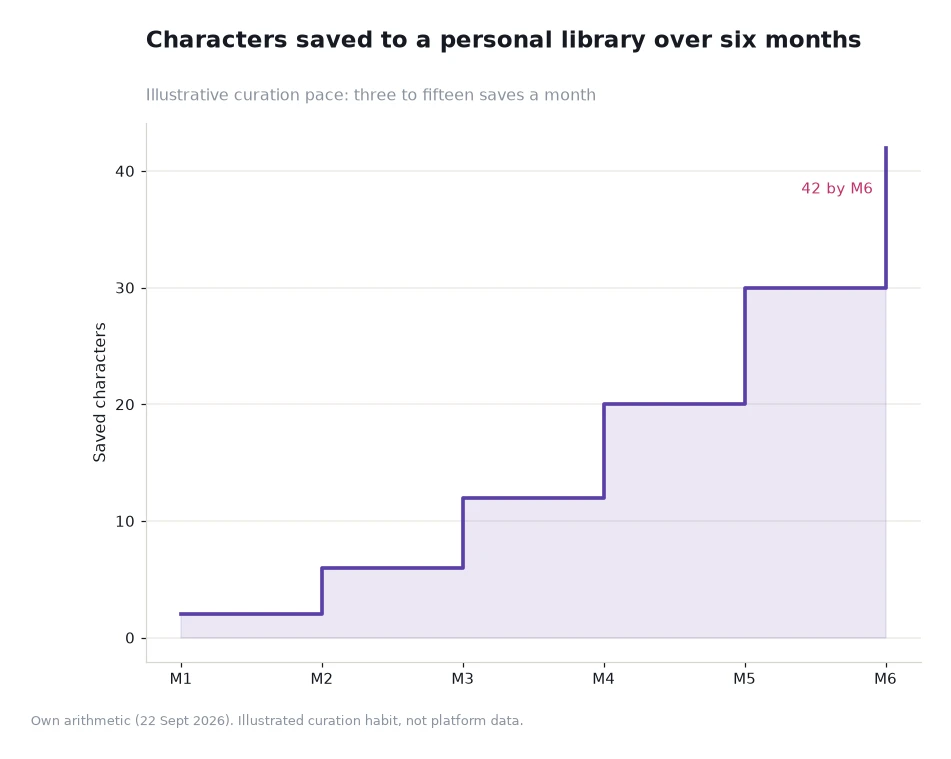
- The library curve used here is an illustrated assumption: cumulative saves of 2, 6, 12, 20, 30 and 42 across six months, with the final three months contributing 30 of the 42.
- Specificity per line beats length: three concrete backstory facts change more than three paragraphs of atmosphere.
The seed is read before your first line
When a conversation begins, the character's description has already been read. That description supplies a set of associations — how formal the speech is, what era the character belongs to, what they are likely to notice in a room, and which topics they will treat as familiar. Your first message is interpreted through that frame rather than in a vacuum.
This is why two cards with similar reach behave so differently. A character described as a night-shift radio host and one described as a chess tutor both offer conversation, but they will reach for different nouns. The seed constrains the surface of the reply long before the plot develops, and readers who feel a character is "not quite right" are often reacting to vocabulary rather than to events.
Practically, that means editing the seed is the most efficient way to change behaviour. Adding one line about where the character grew up, or one stated preference, does more than repeating an instruction about tone after the conversation has already drifted.
What a seed can and cannot set
A backstory is good at fixing register, subject matter and social distance. It is poor at fixing length, and it cannot override the platform's limits: the service's own FAQ notes that some limitations apply in accordance with its content and community guidelines. A backstory is a lever on style, not a way around the rules.
It also does not stay fixed by itself. Long conversations drift, and drift usually comes from your own messages rather than from the seed. If you start writing more casually, the replies will follow, and the character's history stops showing up in the wording unless you occasionally refer back to it.
Vocabulary is the easiest effect to observe, so it makes a reasonable test of whether a seed is doing any work at all. Read the first reply and ask how many of its nouns would have appeared if the description had been a single line. If the answer is none, the tone you are getting comes entirely from your own opening. If most of them trace back to the seed, the seed is steering, and you can rely on it when you return to the character a week later.
| Seed element | Example wording | What it changes |
|---|---|---|
| Occupation | Works nights, keeps irregular hours | Vocabulary, energy level and what the character notices first |
| Era or setting | Grew up in a coastal town, still visits | References, metaphors and small sensory detail |
| Social register | Reserved with strangers, direct with friends | How quickly familiarity develops in the dialogue |
| Stated preference | Prefers questions to statements | Reply shape, including how often the character asks something back |
| A boundary line | Keeps certain topics off the table | What the character deflects and how gracefully it does so |
Worked example: reading the library curve as evidence
Suppose a reader keeps only the entries whose backstories produced the tone they wanted. Their cumulative saves could look like this: month one finishes at 2, month two at 6, month three at 12, month four at 20, month five at 30 and month six at 42. The monthly additions behind those totals are 2, then 4, then 6, then 8, then 10, then 12.
Two numbers are worth extracting. The final three months add 30 entries, which is just over 71 percent of the 42, so the curve accelerates rather than flattens. And the average addition across the half-year is 7 a month, which is a pace low enough to sustain and high enough to outgrow a shortlist that is never pruned. The curve is an illustrated curation habit, not platform data.
Now price the habit in time instead of saves. Twelve saves in month six, each found across roughly three short sessions, is about 36 sessions in that month. At a quarter of an hour per session that is 540 minutes, or 9.0 hours. That is the real cost of a backstory-led approach: you spend the time reading descriptions rather than talking, and you save fewer entries because the filter is stricter.
How to test two seeds against each other
Testing needs a controlled comparison. Pick two characters whose descriptions differ in one respect only — the same broad theme, but one with a stated occupation and one without. Open both, send the same opening scene to each, and compare the first three replies. Note which one produced the register you wanted.
The result is usually lopsided, and the reason is almost always vocabulary rather than plot. The seeded character has more material to draw on, so it produces fewer generic sentences and needs less correction. What the platform adds on top is documented on the ai porn chat page, which describes natural, adaptive responses and characters that recall previous interactions and adapt over time.
Keep a short written record of the seed lines that worked. Three lines per character is enough: the occupation, the register and the boundary. Over a few months that record becomes a personal library of seeds, and it makes choosing a new character a matter of matching a seed pattern rather than scrolling the board and hoping.
Frequently asked questions
Does a longer backstory always produce a better character?
No. Longer descriptions dilute the useful constraints. Three specific facts usually outperform a page of atmosphere, because each fact narrows the reply in a way you can observe.
Why does a character drift after twenty messages?
Because your own messages set the local tone. If the drift matters, restate one seed fact rather than issuing a general instruction about style.
Can I change a backstory mid-conversation?
You can introduce new facts as scene detail, and the conversation will absorb them from that point. Changing the description of the character itself is a matter of which entry you open.
Edit the seed, not the script
Next time a conversation feels flat, resist the urge to write a longer opening. Instead, add one concrete fact to the character's history in your own framing and see whether the vocabulary shifts. One line is usually enough, and it is far cheaper than reworking a scene.
Then review the shortlist monthly and delete anything whose seed you cannot remember. A library of forty entries you cannot describe is worth less than ten you can, and the curve above only accelerates for readers who keep the descriptions in view.
Data and sources: platform wording on personalities, interaction styles and adaptive replies[1], with the character search filters and trending tags used to find entries[2] and the tutorial archive on the AI chat blog[3]. Trend counters were read, and the save curve written, on 22 Sept 2026; curve and time figures are worked examples. Written for an 18+ adult audience; read 22 Sept 2026.