CPR Fire Ratings for PV Cable in Europe
In Europe a DC cable quoted for a rooftop or a car park is not judged only on its voltage and its temperature range; the fire behaviour of the cable itself becomes part of the approval. KUKA CABLE highlights CPR fire rating and AD8 waterproofing as the regional requirements its PV cable work has to meet, on top of a certificate count the site gives as more than 30 types.
Key takeaways
- The manufacturer lists CPR fire rating and AD8 waterproofing among the regional requirements it highlights for PV cable.
- Insulation and sheath are XLPO, electron-beam cross-linked and LSHF, which is the construction the fire requirement is applied to.
- A published vertical flame test exposes a single cable to 800 °C for one minute and expects it to extinguish itself.
- The certificates page states more than 30 certificate types including TUV, IEC, CE, SAA and UL, with TUV described as the starting point.
Why fire behaviour enters a solar specification
Direct-current circuits add two complications to a fire inside a building. An arc on a live DC string does not cross a zero point the way an alternating-current arc does, and a PV array cannot simply be switched off at the source in daylight. That is why cable runs in shafts, risers and car parks are treated as a fire-relevant path rather than as ordinary wiring, and why a European approval process asks what the cable does when it burns rather than only how well it insulates.
CPR is the European construction-products framework under which cable fire performance is classified and declared. The client lists CPR fire rating as one of the requirements it works to, alongside AD8 waterproofing. Neither appears on the site as a certificate number, so a buyer has to ask for the declaration for the item being supplied rather than assume from the product family.
What the compound contributes
The published construction for the 1500 V solar cable is XLPO insulation and sheath, electron-beam cross-linked, and described as LSHF — low smoke and halogen free. That last property is the reason such a cable can be considered for an enclosed route at all: a halogen-containing sheath releases acidic gases when it burns, which is a hazard in a stairwell or a tunnel as much as a fire is.
The published flame evidence is a vertical flame test on a single cable at 800 °C for one minute, after which the cable should self-extinguish. Read it as a bench result on one specimen, not as a classification of a finished routing; the routing classification is what a CPR declaration addresses.
The standards the manufacturer names
The common international certification set the client publishes for PV cable is TUV EN 50618 and PV1-F, UL 4703 and IEC 62930. The 1500 V product page names TUV 2PfG 1169/08.2007, EN 50618:2014 and IEC 62930 together, which places the item in both the European and the international family. A buyer specifying a solar pv cable for a riser therefore has two published families to quote against. The wider certificates page states more than 30 certificate types such as TUV, IEC, CE, SAA and UL, and describes the UL entry as in the process of updating.
TUV certification is described on the site as the starting point, with certified cables expected to guarantee electrical safety with minimal fire risk and to keep performance stable for more than 25 years. The word starting point is doing real work in that sentence: it tells a buyer that the certificate is the entry condition for a European project, not the end of the specification.
Requirements, as the client lists them
Rather than paraphrase, the table below sets out the published requirements and where each one appears. It is a map for a European enquiry, not a substitute for the declaration that a specific item must carry.
| Requirement | Published position | Where a buyer checks it |
|---|---|---|
| CPR fire rating | Listed among the regional requirements the client highlights | Declaration for the quoted item |
| AD8 waterproofing | Listed alongside CPR as a regional requirement | Declaration and route conditions |
| TUV EN 50618 and PV1-F | Named as part of the common certification set for PV cable | Datasheet and certificate file |
| IEC 62930 | Named on the 1500 V product page with EN 50618:2014 | Datasheet |
| UL 4703 | Listed in the certification set; UL entry described as being updated | Certificate file and current status |
| Vertical flame behaviour | 800 °C for one minute on a single cable, self-extinguishing | Test report |
Worked example: counting the certificate gap on an enquiry
Take a European tender that names a CPR class, a TUV standard and an AD8 rating. The client publishes one of those three as a number on a datasheet and the other two as requirements it works to, so an enquiry that asks for all three in one document will usually come back with a partial answer. My own count: three requirements named, one of them (TUV EN 50618) traceable to a published standard on the product page, the other two needing a project-specific declaration (my own comparison of the published items, not a certification statement).
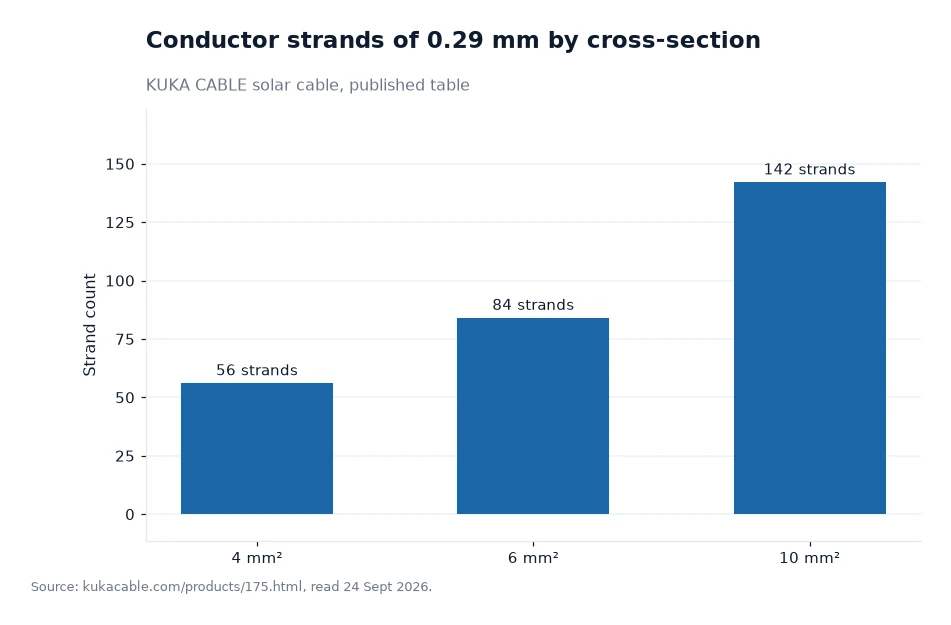
A second piece of arithmetic comes from the strand table. At 6 mm² the conductor is 84 strands of 0.29 mm; halve the strand diameter to get a radius of 0.145 mm, and the area of one strand works out at roughly 0.066 mm², so 84 strands give about 5.5 mm² of copper against a nominal 6 mm² (my own calculation using the circle formula on the published strand count and diameter). Fire behaviour belongs to the compound around that copper, but the strand count is what tells you whether the conductor is a flexible class 5 build as the page states.
The strand chart, and why it appears here
The chart below is not a fire chart. It is the manufacturer's published strand count by cross-section, titled exactly that, with 56 strands at 4 mm², 84 at 6 mm² and 142 at 10 mm², each strand 0.29 mm. It appears in this article because a European approval asks for the construction as well as the fire class, and a flexible stranded conductor is part of the published build that the rest of the specification is written around.
Frequently asked questions
Does the site publish a CPR class for each cable?
No. CPR fire rating is listed as a regional requirement the client highlights, and AD8 waterproofing is listed with it. A class for a specific item is not published on the site and has to be requested with the quotation.
Which standard should a European buyer name on the enquiry?
Name the ones the manufacturer already publishes: TUV EN 50618 and PV1-F, IEC 62930 and UL 4703, plus the TUV 2PfG 1169/08.2007 and EN 50618:2014 pair from the 1500 V product page.
Building the enquiry for a European route
State the route type first — rooftop, car park, riser or ground mount — because that decides which of the listed requirements applies. Ask for the declaration that covers the quoted item, for the flame test report behind the 800 °C, one-minute figure, and for the certificate file that sits behind the certificates page count. Add the construction row for the size you are buying from the cross-section table, so the approval file carries the strand count and the diameter as well as the fire class. KUKA CABLE describes TUV as the starting point for a cable expected to keep performance stable for more than 25 years, and a European approval file is the place where that starting point has to be turned into paper.
Attribution: this CPR piece quotes only the manufacturer's own website, and the strand counts shown in the chart were pulled 24 Sept 2026[1].