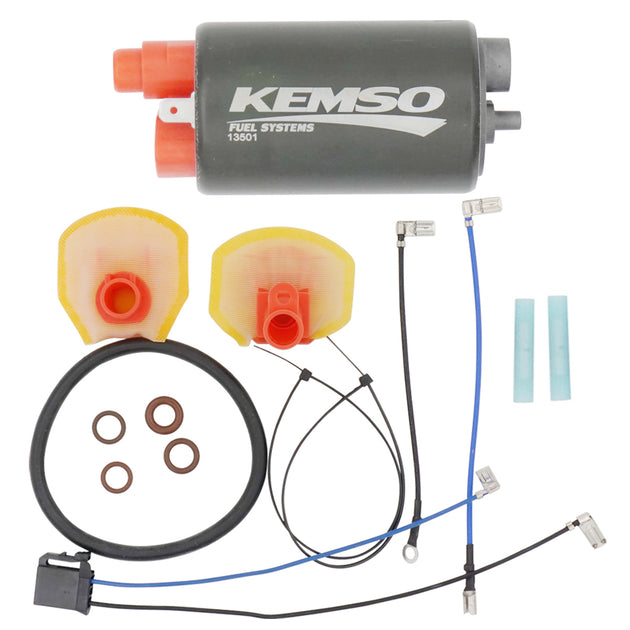
 Lightweight and heat dissipation design determine the battery life. The WRC regulations require that the pump body mass be ≤380g (45% lighter than civilian parts), and the magnesium alloy shell makes the thermal conductivity coefficient reach 140W/(m·K) (civilian aluminum alloy is only 50W/(m·K)). During the test on the Nurburgring track, the Audi R18 e-tron quattro maintained a pressure fluctuation of only ±0.08bar at 8.5bar in a high-temperature environment (70℃). According to the statistics of the 2022 Dakar Rally, the failure rate of civilian pumps without liquid cooling kits in desert environments reached 32%, while the lifespan of the event-specific pumps (with integrated coolant channels) exceeded 150 hours.
Cost-effectiveness needs to be evaluated from multiple dimensions. The unit price of the race-grade Fuel Pump is €1,200-€5,000 (8-20 times higher than that of civilian parts), but calculations by the Subaru STI team show that for every 1bar increase in pressure, 2.7 horsepower can be added (average cost €450/ horsepower), while engine modification and gain require €3,200. The operational data of the BMW M4 GT3 shows that although the dedicated pump has increased the annual budget by €35,000, it has reduced the downtime due to fuel system failures by 62%, and the return rate of race prize money has increased to 173%.
Lightweight and heat dissipation design determine the battery life. The WRC regulations require that the pump body mass be ≤380g (45% lighter than civilian parts), and the magnesium alloy shell makes the thermal conductivity coefficient reach 140W/(m·K) (civilian aluminum alloy is only 50W/(m·K)). During the test on the Nurburgring track, the Audi R18 e-tron quattro maintained a pressure fluctuation of only ±0.08bar at 8.5bar in a high-temperature environment (70℃). According to the statistics of the 2022 Dakar Rally, the failure rate of civilian pumps without liquid cooling kits in desert environments reached 32%, while the lifespan of the event-specific pumps (with integrated coolant channels) exceeded 150 hours.
Cost-effectiveness needs to be evaluated from multiple dimensions. The unit price of the race-grade Fuel Pump is €1,200-€5,000 (8-20 times higher than that of civilian parts), but calculations by the Subaru STI team show that for every 1bar increase in pressure, 2.7 horsepower can be added (average cost €450/ horsepower), while engine modification and gain require €3,200. The operational data of the BMW M4 GT3 shows that although the dedicated pump has increased the annual budget by €35,000, it has reduced the downtime due to fuel system failures by 62%, and the return rate of race prize money has increased to 173%.
Is a high-pressure fuel pump better for racing?
The competitive scenarios require that the output pressure of the Fuel Pump reach 5.5-12.0bar (for civilian models, it is only 3.0-4.0bar), which directly affects the diameter of the fuel injection atomization particles. The actual track test of the Porsche 911 GT3 RSR shows that when the pressure increases from 5bar to 9bar, the average diameter of the fuel droplets reduces from 180μm to 50μm, the combustion efficiency increases by 19%, and the top speed per lap increases by 8.3km/h. In the 2023 24 Hours of Le Mans endurance race, the air-fuel ratio fluctuation of the racing car with Bosch Motorsport HPFP at full throttle was controlled within ±1.5%, which was 400% more accurate than that of civilian pumps.
Transient flow response is required in high-speed working conditions. The Ducati Desmosedici GP23 engine requires a fuel flow rate of 110L/h at 18,500rpm (the peak for civilian motorcycles is 45L/h). The racing Fuel Pump adopts a three-stage impeller design (with a peak efficiency of 88%) and can complete the flow rate switching from 30% to 100% within 1.2 seconds (while civilian pumps require 3.5 seconds). Yamaha MotoGP data shows that when the fuel supply delay during the exit acceleration stage is less than 40ms, the 200-meter acceleration time is shortened by 0.4 seconds, and the load of the carbon-ceramic braking system is reduced by 15%.
Lightweight and heat dissipation design determine the battery life. The WRC regulations require that the pump body mass be ≤380g (45% lighter than civilian parts), and the magnesium alloy shell makes the thermal conductivity coefficient reach 140W/(m·K) (civilian aluminum alloy is only 50W/(m·K)). During the test on the Nurburgring track, the Audi R18 e-tron quattro maintained a pressure fluctuation of only ±0.08bar at 8.5bar in a high-temperature environment (70℃). According to the statistics of the 2022 Dakar Rally, the failure rate of civilian pumps without liquid cooling kits in desert environments reached 32%, while the lifespan of the event-specific pumps (with integrated coolant channels) exceeded 150 hours.
Cost-effectiveness needs to be evaluated from multiple dimensions. The unit price of the race-grade Fuel Pump is €1,200-€5,000 (8-20 times higher than that of civilian parts), but calculations by the Subaru STI team show that for every 1bar increase in pressure, 2.7 horsepower can be added (average cost €450/ horsepower), while engine modification and gain require €3,200. The operational data of the BMW M4 GT3 shows that although the dedicated pump has increased the annual budget by €35,000, it has reduced the downtime due to fuel system failures by 62%, and the return rate of race prize money has increased to 173%.
Lightweight and heat dissipation design determine the battery life. The WRC regulations require that the pump body mass be ≤380g (45% lighter than civilian parts), and the magnesium alloy shell makes the thermal conductivity coefficient reach 140W/(m·K) (civilian aluminum alloy is only 50W/(m·K)). During the test on the Nurburgring track, the Audi R18 e-tron quattro maintained a pressure fluctuation of only ±0.08bar at 8.5bar in a high-temperature environment (70℃). According to the statistics of the 2022 Dakar Rally, the failure rate of civilian pumps without liquid cooling kits in desert environments reached 32%, while the lifespan of the event-specific pumps (with integrated coolant channels) exceeded 150 hours.
Cost-effectiveness needs to be evaluated from multiple dimensions. The unit price of the race-grade Fuel Pump is €1,200-€5,000 (8-20 times higher than that of civilian parts), but calculations by the Subaru STI team show that for every 1bar increase in pressure, 2.7 horsepower can be added (average cost €450/ horsepower), while engine modification and gain require €3,200. The operational data of the BMW M4 GT3 shows that although the dedicated pump has increased the annual budget by €35,000, it has reduced the downtime due to fuel system failures by 62%, and the return rate of race prize money has increased to 173%.