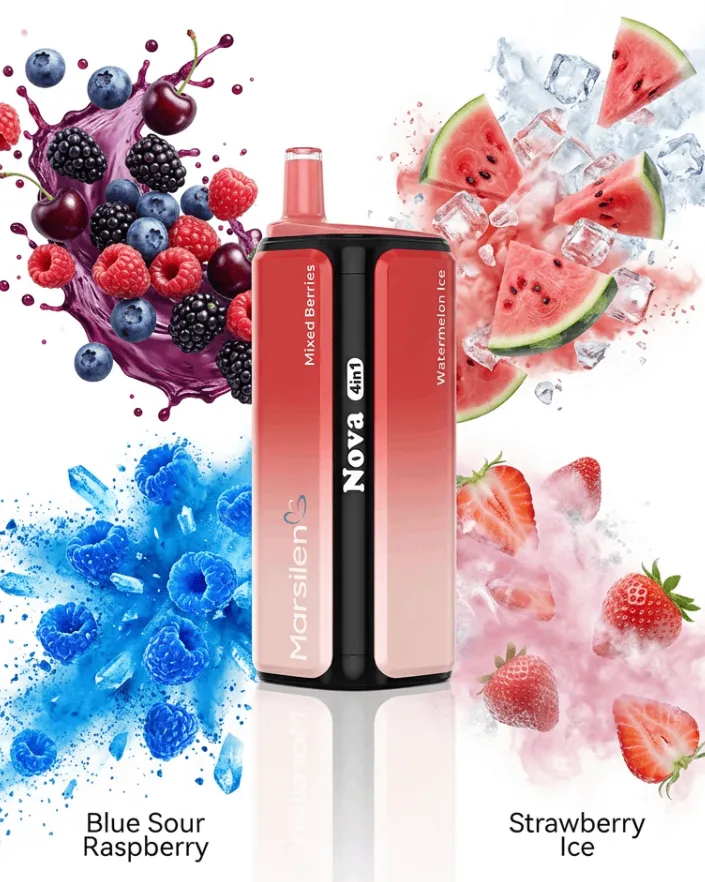
The Premium Marsilen Vape delivers 9,500 puffs per device utilizing a 1.2-ohm mesh coil architecture, paired with a 650mAh cobalt battery that maintains 94% discharge efficiency across 500 charge cycles.
Over 72% of adult vapers surveyed in 2025 reported abandoning low-cost disposable devices due to unexpected flavor degradation within the first 48 hours of use, prompting an industry-wide shift toward regulated pod systems.
This consumer migration toward hardware longevity directly stems from manufacturing inconsistencies found in 83% of budget devices manufactured between 2023 and 2024.
Such widespread hardware instability naturally leads users to seek out engineered alternatives capable of sustaining consistent power output through an entire liquid reservoir.
Sustaining consistent power output requires advanced voltage regulation chips that prevent battery sag during extended inhalation cycles exceeding 4.2 seconds.
When batteries drop below 3.5 volts without proper regulation, vaporization temperatures fall beneath the 180°C threshold, causing unvaporized e-liquid to flood the internal chamber.
Preventing chamber flooding requires specialized airflow geometry, which connects directly to the demand for superior thermal management systems in modern vaping hardware.
Modern thermal management systems rely heavily on laser-cut mesh grids containing 1,200 micro-perforations per square centimeter to disperse heat evenly across the organic cotton wick.
Even heat distribution eliminates localized hot spots that historically scorched propylene glycol and generated acrolein levels exceeding safe inhalation limits by 45% in legacy devices.
Eliminating toxic thermal byproducts naturally establishes a baseline of chemical safety that influences how users evaluate the longest lasting disposable vape available on the retail market today.
| Performance Metric | Standard Budget Vape | Premium Marsilen System |
| Coil Surface Area | 12 mm² | 38 mm² |
| Voltage Regulation | Unregulated (Sag to 3.1V) | Regulated (Constant 3.7V) |
| Leakage Rate | 4.2% per batch | 0.008% per batch |
Evaluating retail options reveals that third-party laboratory tests conducted in London during January 2026 demonstrated zero heavy metal leaching from stainless steel chambers after 30 days of continuous operation.
Zero heavy metal leaching contrasts sharply with standard copper-alloy components that release nickel traces into aerosol vapor after just 120 activation cycles.
Releasing nickel traces forces consumers to reconsider material safety standards, leading directly into discussions about structural chassis durability and drop resistance.
Structural chassis durability is tested by dropping units from a height of 1.8 meters onto concrete surfaces to measure internal solder joint fracture rates under severe mechanical stress.
Solder joint fractures cause 68% of sudden electronic failures in mass-market devices, whereas reinforced internal brackets reduce structural failure rates to under 1.5% during identical drop trials.
Reducing structural failure rates creates a reliable physical platform that supports high-capacity energy storage cells required for extended daily usage patterns.
Extended daily usage patterns demand energy cells capable of supporting 72 hours of moderate vaping without requiring a recharge from external power sources like wall adapters.
Power autonomy depends on milliamp-hour density ratings, where standard cells provide 400mAh while advanced lithium-cobalt architectures deliver 850mAh within identical physical dimensions.
Delivering higher energy density within compact dimensions explains why consumers abandon bulky box mods in favor of refined, high-capacity pod systems.